Showing posts with label Islam. Show all posts

Sunday, 24 March 2013

Women's Clothes in Sudan

(For this series of posts, I would really like to get input from the Sudanese to be as accurate as possible. Please comment if I wrote something that is only partly true or could be misunderstood or is just obviously wrong. Thanks!)

Note: This post is part of a series on what Khartoum is like.  It is intended for anyone coming to Sudan who wants to learn more and get advice on various topics before travelling here, and anyone else interested.

When I came to Sudan I was told to bring clothes that would cover much of my skin--long skirts, at-least-elbow-length high-necked shirts, etc.).  But despite this foreknowledge and having grown up donning a skirt whenever I exited our compound, I was surprised once I arrived here and saw for myself how stringent the (spoken or unspoken) rules were, especially for Sudanese women.  Most women in Khartoum (maybe 95%) cover themselves from ankle to wrist, and a majority (maybe 80%) cover their heads up to the chin and forehead.

Of course this was new to me, but I realized right away how beautiful Sudanese style is.  Women coordinate their colors in such a pretty way.  (I would have more pictures to show that, except that not all women allow their pictures online--hence Facebook accounts with models or cartoon characters as profile pictures.)
In general, I've noticed three main styles of dress in Khartoum: Sudanese, Saudi, and Western.  The traditional Sudanese garment is called a tobe--a long length of cloth wrapped around the waist and shoulders and draped over the head, similar to an Indian sari.  Tobes are worn with a skirt and shirt underneath and often a hijab pinned tight underneath, too.

In general, girls don't wear tobes or start wearing them upon marriage, although single women do wear them.  In Khartoum, for the most part, only older women wear them habitually while younger women wear them for special occasions, such as weddings.
My friend sports a lovely green tobe and matching yellow hijab. I edited this picture after it was first posted to keep my friend's face offline. 
In my opinion, tobes are really pretty but really impractical.  A woman wearing a tobe seems to be forever adjusting it, and they always seem to fall completely off when a woman gets off a bus.
3 sisters: Western, Saudi abaya, Sudanese tobe
Some Sudanese women wear the Saudi abaya--an enormously wide dress of generally thin, shiny material with embroidered patterns.  Under this, also, Sudanese women wear a shirt and skirt or trousers.  Perhaps this is because the abaya is made of such thin cloth.  Some women wear abayas for religious reasons (and sometimes this is accompanied by the face-covering niqab, stockings over feet, and handgloves--though handgloves are worn more often to protect from a tan than for religion).  Others wear the abaya because of its aesthetics.

Finally, most women in Khartoum dress in Western clothes, (that is, I assume the clothes are originally from the West, but does not mean they dress like Westerners) such as an ankle-length denim skirts, a long-sleeved shirt, another top layered over that, and a hijab crowning the outfit.  The more daring women wear trousers with long shirts/dresses, that come down to their knee, or at least to upper thigh.

For women thinking of visiting Sudan, you might feel like you have to buy an entirely new wardrobe.  It's pretty much true.  You can bend the unspoken rules, and as a foreigner, you can get away with a lot more than the Sudanese, but here are some recommendations on what to get before coming to Sudan.

Things I'm glad I brought/wish I had:

  • long-sleeved shirts
  • undershirts with high necks that you can wear under shirts with low necks
  • tank tops/spaghetti straps that you can layer on top of other shirts
  • those sleevey things that are basically a set of long sleeves to wear on top of a tank top--I'm not sure what they're called
  • long skirts--especially denim or plain color to match with anything (check charity/thrift shops, or you can buy them in markets in Khartoum)
  • at least one pair of jeans
  • dress pants
  • if you plan to wear hijab, come with one or two and buy most after you arrive as they are much cheaper here.
  • (But also bring some normal clothes because you'll want to wear shorts and t-shirts while in your own house or jeans at an expat party.)


Guidelines:

  • Shirts: elbow-length to wrist-length, no cleavage, long enough so there's never skin showing between your skirt and shirt, not skin-tight.
  • Skirts: preferably ankle-length (and the so-long-that-I'm-sweeping-the-entire-pavement-around-me length is in style in Sudan) but at least longer than midcalf, not skin-tight. Slits are okay to mid-calf, but are preferably worn with leggings.
  • Trousers: not skin-tight, with a longer shirt or dress that preferably covers your bottom.
All those guidelines will feel impossible to keep all the time, and you don't have to.  When you come to Sudan, you'll figure out what you're comfortable with and what level of restriction drives you bonkers.  I break the "rules" regularly and so do all the other volunteers, but they'res good guideline to start from.

And I'm sorry this got to be 5 pages long and as technical as a Pentagon plan-book to keep spiders from the President's morning coffee.

Saturday, 26 May 2012

Khartoum: Expectations

Khartoum is definitely not what I expected.  Sure, it's still Africa, but I find few similarities between here and Malawi, or even the rest of Southern Africa that I've been to.  As I mentioned before, I was surprised that people here drive on the right side.  Here are some other things that surprised me:

Sudanese Arabs are very dark-skinned.  For many, I can't tell the difference between Arabs and Blacks except for their hair texture.  I'm still confused about this; I've read that most Sudanese are Arab, but I guess they don't fit my silly stereotype of Arabs.  South Sudanese are very distinctive, though, because they are really tall and really dark-skinned, and I've seen quite a few.

Continuing the ethnic theme, there are very few Whites here.  Beyond meeting 6 Whites through friends, I've probably only seen about 5 out in the street--and I've been in the street a lot.  In Malawi, we called these "whitey-sightings."  Whitey-sightings are definitely fewer in the 2-million-plus Khartoum than in my humble 30 thousand home-town of Mangochi!

I have only seen 2 fuel stations.  I only started looking out for them on Friday, but it's a distinct contrast to Malawi, where they feature prominently in cities.  I've also not seen any supermarkets or malls, though I'm told there are at least 2 supermarkets.  Shops here seem to be either small kiosks, specialized shops (like electronics), or restaurants.

In the bustling metropolis of Blantyre (Malawi), the sidewalks roll up around 8:00, and in Mangochi, the streets are empty at 6:30.  Here, the sun doesn't go down until 7:30, and people are up and about for hours later.  I suppose it never completely quiets down, but I'd guess it's mostly quiet by 1 am.  Not only are people out late, shops are still open and you can still catch public transport after midnight!

The toilets here are somewhat dirtier than Malawi, and all are squatties, even in nice places!  But the worst part is that they don't have toilet paper, because Muslims wash with water.  Toilet paper has become a precious commodity to me, and I have to take it with me everywhere.

There are many things I love about Khartoum, some of which I've mentioned in previous posts: the public transport, friendliness of Sudanese, AC in my bedroom, later sunset, and the big city feel.  I also like the prices--some things, for sure, are expensive, like transport (much more than in Malawi), but other things are really cheap (in my estimation), like cellphone credit, Internet, and electricity.  Food is comparable to prices in Malawi, I think, which is expensive compared to the US.

I also love the generosity.  I've already learned so much about what real generosity is: it doesn't say "Do I have enough for myself? Then I can give whatever I have extra."  It's absolutely refreshing to stop being selfish and thinking of myself first.  I've always wondered, how much do I take away from saving to give?  And this experience has added valuable thoughts on the subject.

Of course, there are also things I need to adjust to (that's polite for "I don't really like it"), but as you'll see, they're all minor.

Feeling stuffed.  I'm used to cleaning my plate.  But when someone else fills your plate, it's impossible to eat everything.  So I'm trying to learn the right balance of polite acceptance and knowing my stomach's limits.

Water Intake.  Khartoum is very dry and hot, so I'm constantly reminded to drink lots of water, which I've tried to do.  For my first few days, I collected about 3 or 4 water bottles each day, because I refused to throw them out in the street.  It's an adjustment to drink so much.  Cold water doesn't stay cold for long, so I'm getting used to drinking lukewarm and water so hot it could be coming from the hot water tap!

Heat.  Need I even mention this?  Most of the time, the temperature is in the 90s or 100s Fahrenheit.  I don't actually mind the heat too much, which is mostly because I psyched myself up for it so much; I was actually prepared for it to be worse and for me to be miserable.

"Dress code."  Of course, the need to cover up exacerbates the heat.  Women are covered from ankle to wrist to face.  I can't recall seeing any female forearms, and most cover their necks.  At the same time, men wear long trousers and many also wear long-sleeved shirts.  So this is something that's a little bit annoying because it makes me hotter and I'm stuck wearing the same skirt most days (this is because trousers must be warn with very long shirts, and most of my shirts are normal-length).
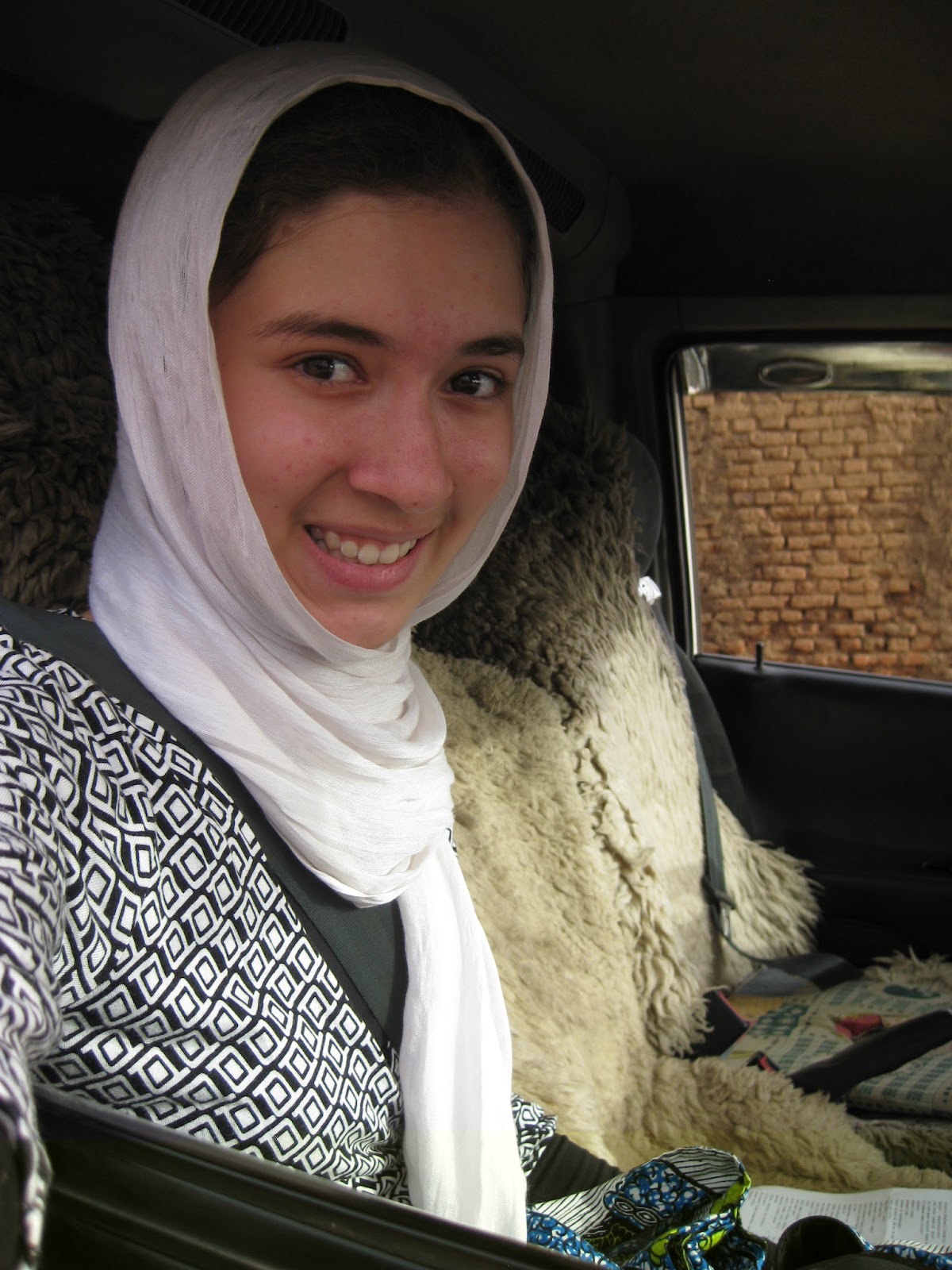
in my Sudanese garb
On the other hand, women generally look really beautiful in attractively-matched scarves, long-sleeved shirts (often with a "Western" shirt on top), and floor-length skirts.

Sudanese flat.  The flat I'm sharing with Tanya is large, and has AC, a clothes-washer so I really can't complain.
Our flat is on the third floor of this building

my room

But even in Malawi, I lived in a Western house, so it's a bit of an adjustment living in an un-western house.  The kitchen is rather un-equipped, but that's always something I can work on!  On Friday I put my pictures up on my bedroom wall, and it's really becoming home.  I also love that our flat has a huge patio and that we live higher up.
view from our patio
Last but not least, I need to adjust to the discrimination against my dear toilet paper and learn to take it everywhere with me :)